


A 20th-anniversary screening of the groundbreaking documentary brought together alumni, students, educators, and advocates to reflect on the film's legacy — and the ongoing work of building communities where every student can live authentically.
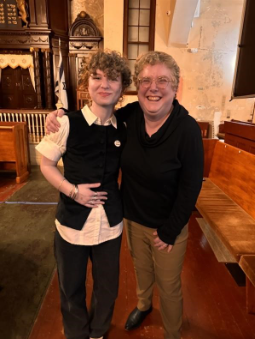
Liana G. '26 and Dr. Susie Tanchel at the Vilna 2026 celebration

Community members gathered at the historic Vilna Shul in Boston on February 12 for a 20th-anniversary screening of the documentary Hineini: Coming Out in a Jewish High School. Inside the restored 1919 sanctuary, arched windows with stained-glass accents and vintage chandeliers served as the backdrop for a conversation among four individuals closely connected to the film's legacy. The setting created a striking juxtaposition: a contemporary discussion of LGBTQ+ belonging within one of Boston's oldest Jewish sacred spaces.
More than a retrospective, the anniversary offered an opportunity to reflect on how one student's courage, along with the support of openly LGBTQ+ faculty and allies, helped reshape conversations about belonging in Jewish schools. The film's story first unfolded at 网上买球线上平台, where those early efforts continue to shape how the community understands belonging today.
The evening included a panel discussion featuring Jaimie Krass (President and CEO of Keshet, a national organization working to advance LGBTQ+ equality and inclusion in Jewish life), Idit Klein (a producer of Hineini and former Keshet CEO), Dr. Susie Tanchel (beloved former 网上足彩买球 teacher, Associate Head of School, and parent), and Liana G. '26 (current GSA Co-President at 网上足彩买球), who reflected on the documentary's lasting impact and ongoing efforts across Jewish educational communities. The evening brought together alumni, educators, and current students connected to 网上买球线上平台 past and present, underscoring how the story captured in Hineini continues to resonate across generations of the school community. That legacy can be traced back to the film's original release.
The Film's Origins
When the film premiered in 2005, it helped reshape LGBTQ+ inclusion in Jewish education, drawing national attention to how students, educators, and allies together were working to build more inclusive school communities. As director Irena Fayngold later reflected, the film ultimately became "the story of a community," capturing how students, teachers, and families together wrestled with questions of belonging. Directed and produced by Fayngold, the documentary chronicles the coming-out story of alumna Shulamit Izen '02 within her school community, exploring how Jewish tradition and lived experience come into dialogue.
Before becoming an activist, Shulamit's journey began as a deeply personal struggle. She cherished being part of a vibrant Jewish learning environment filled with classes, rabbinic mentors, and opportunities to explore her faith, yet wrestled with how to reconcile her commitment to traditional Judaism with her growing understanding of herself as a queer woman, questions that would later shape both her activism and her professional calling. As her father, Myles Kleper, reflects in the film, "I don't think she could possibly give up either side of the coin. She is Jewish, and she's a lesbian. And she's just going to have to keep moving slowly towards however that comes together."
For many families, that journey unfolded gradually and not without fear, shaped by questions about faith, identity, and belonging. For students like Shulamit, it also meant taking the courageous step of helping create the very spaces where belonging could take root. Looking back, Shulamit later reflected that "there was a space in the Jewish community for all that I am," a realization shaped by the work of helping build that space for herself and for others.
Finding Community
Ultimately, Shulamit organized conversations among students and faculty, interned with Keshet, and helped establish what became Open House, an early initiative that paved the way for the student alliances now common in many schools. At the time, organizing a Gay-Straight Alliance in a religious school setting was far from typical, making the effort both logistically and culturally challenging. Many of the student-led structures that grew from those early efforts continue today at 网上足彩买球. The GSA remains an active part of student life.
While Shulamit's voice helped catalyze change, she was not acting alone. A small group of openly LGBTQ+ faculty, including Dr. Tanchel, along with committed allies, quietly supported the early community discussions that would reshape the school's culture.
A Legacy That Continues
The Hebrew word hineini, meaning "here I am," captures the spirit at the heart of the film: a declaration not only of presence, but of readiness to step forward with courage and responsibility. Speaking during the post-film discussion, Dr. Tanchel noted, "One of the lessons for me is for adults to take kids seriously … to be open to what they are thinking about and what they're feeling, both hearts and minds, to see their courage, to mirror it for them, and to be open to learning something."
Twenty years later, the anniversary gathering highlighted how that courage, now shared across students, educators, and community leaders, continues to influence Jewish educational spaces. "Part of what gives me hope," Dr. Tanchel shared during the discussion, "is working with our students to be educators and rabbis who represent such a different Judaism than the one I grew up with." For today's students, belonging means living authentically and visibly. Speaking during the post-film discussion, Liana G. '26 described belonging as an "unwillingness to tuck away parts of yourself."
Why the Conversation Still Matters
The anniversary also comes at a moment when the questions raised in Hineini feel newly urgent. According to research from The Trevor Project, roughly 90% of LGBTQ+ young people report that today's political climate negatively affects their well-being, and hundreds of anti-LGBTQ+ bills continue to be introduced across the United States each year. This is a sobering reminder that conversations about safety, belonging, and visibility remain deeply relevant for today's students, and that the work highlighted in Hineini is far from finished.
Marking the 20th anniversary was more than a nostalgic look back. It was a chance to reflect on how much can change when one student finds the courage to speak, and when others choose to stand beside them. Two decades later, the story of Hineini is still unfolding — in the classrooms, conversations, and communities where more students can live openly and authentically.